Sunday, January 07, 2024

New Year's Resolutions and The Epiphany


Ephesians 3:1-12 (p1174)

Matthew 2:1-12 (p966)


INTRODUCTION: New Year’s resolutions?


What? How? Why?


READINGS


Not just me, but Christ


Focused on ourselves


Take a look at ourselves maybe, but fix your eyes on Christ

Two looks at Christ for every look at self


A resolve to seek Christ


Whatever the cost


The cost for the wise men


“The East”


Babylon? – Daniel a wise man in Babylon – just a guess!


Babylon – near Al-Ḥillah in Iraq, 55 miles south of Baghdad

684 miles to Jerusalem and Bethlem

259 hours of walking – 6 hrs a day – 43 days of walking

And back again, perhaps by the long way!


Difficulty, expense, danger

The whole of life on hold for a few months

Risking their lives


Not just my failings (or achievements), but Christ’s glory


When we look at ourselves, what do we see?


Cf. our failings or achievements


A positive vision of the glory of Christ


Worship him!


Give him their gifts!

Lay their all at his feet

Honour him


The King of Kings, of whom we should make much


Whom we should obey

For whom we should risk all


Jesus’ glory


Paul: “the unsearchable riches of Christ” (Ephesians 3:8)


Richest person in the world

Forbes: Elon Musk - Net worth: $251.3 billion

He was the richest person in the world for much of 2022 as well.

His fortune rose by $6 billion during December 2023.


You can’t know how rich Christ is!


Inexhaustible


Why seeking to know Christ better would always be a great resolution!


Not just for me, but Christ’s glory for all the nations


Jesus is too good to keep to ourselves!


Paul a prisoner / a servant for the sake of the nations


All people


Mystery – secret now revealed


The non-Jewish nations like us are invited in

Ephesians 3v6

Co-heirs with Israel

Co-members of the same body

Co-sharers in the same promise in Christ Jesus


Will I seek Christ whatever the cost?


How could I serve God’s gospel purposes this year with my time, effort, money, prayers, by how I live and speak?

Friday, January 05, 2024

A response to Kate Andrews, In Search of a Second Epiphany

 On the eve of the Feast of the Epiphany, I want to say something, if I may, in response to Kate Andrew’s thoughtful and moving Spectator piece (16 December 2023), ‘In Search of a Second Epiphany’. 


https://www.spectator.co.uk/article/in-search-of-a-second-epiphany/


I hope it will not seem patronising to commend Andrews for her honesty and her seeking. She expresses cogently what many feel. Despite the dominance of scientific materialism in parts of the middle class press and the academy, most people are convinced, as Andrews is, that God exists. “Believing in a higher power has never been the hard part”, she says. “It’s everything that follows as a consequence of having faith which I find difficult.”


There’s much truth in that. As G. K. Chesterton once said: “The Christian ideal has not been tried and found wanting. It has been found difficult; and left untried.” What would a serious commitment to follow Christ day by day mean? I am glad that many go to church on Christmas Eve. But Christ is not just for Christmas. Too right, this way is difficult. All of us veer off it before breakfast. And so moment by moment we need the mercy and compassion of God who knows us better than we know ourselves.  


Andrew’s specific issue is that she finds belief in God brings no particular strength, comfort or assurance. She speaks of the anger over the death of her mother and of God’s failure to intervene to reduce suffering. She says she takes her anger to church. And I think she’s right to do so. God can cope with it. Our anger at pain and injustice is part of the evidence for God, of our being made in his image. If blind chance were all there is, our anger would be nonsensical. Why rage against fluke upon fluke if all your raging is fluke too? But Jesus shared our anger. He drove the money changers from the temple and he snorted with indignation at the damage done to human lives by disease and evil. If we cry out for a better world and for God to act, these are Christian cries.  


Andrews mentions the book of Job. Job’s comforters get little right, but they do go and weep with Job and sit with him in silence for seven days. I hope Andrews has Christian family or friends ready to do that with her. 


Only after more than thirty chapters does the LORD God speak to Job. The Almighty asks Job where he was while God was making the universe. Does Job have some advice for the omniscient one? I realise that is a stark message. The answer of the book of Job is that we don’t have all the answers. None of us. Andrews at least admits it more readily than some of us Vicars sometimes do. Faith means trusting God that he knows what he’s doing, even when we don’t. Job comes to believe that God can do all things and that none of the LORD’s purposes can be thwarted. Inevitably if we speak of God and his ways, we speak of what we do not really understand, things too wonderful for us which we know not. 


Is there more to say, then, than shut up and trust God?


I think there is. A measure of comfort, strength, assurance, peace and joy are possible. And Andrews already points to their source in the life, death, resurrection and return of Christ. 


C. S. Lewis speaks of the elusive nature of joy. Ask yourself whether you are happy or not and your happiness begins to tarnish. It is a mistake to seek peace, joy and strength directly. What we need is Jesus. He gives meaning and purpose and all these things are to found in him. In Jesus alone are the depths of the wisdom and knowledge of God. He is our peace.  


Andrews is right to look to the church and to the Scriptures for Christ. Our feelings are often fickle and can depend as much on our blood sugar levels or our sleep patterns as on reality. Who knows what an epiphany might be like? For some it is spontaneous and overwhelming flood of happiness. For others it is a rational conviction which leads to a commitment to stake everything on Jesus. As a journalist, Andrews knows the importance of the search for truth. As we seek The Truth, we will find him also to be the Way and the Life. Love, joy and peace are to found in Him. I for one am going to go on praying Andrews’ prayer. 


Monday, January 01, 2024

Some potentially useful ideas for a better year


https://drchatterjee.com/13-powerful-ideas-to-make-2024-your-best-year-yet/

Get some time alone with your thoughts. Be still and present. Allow yourself to be bored. Don’t be always connected / accessible / distracted.

Embrace discomfort. Confront your feelings and fears. Your emotions are in flux and change. Much passes.

You can’t control all that happens to you / circumstances, but you can have some control over your responses. We spend a lot of time trying to avoid a future which hasn’t happened yet. Past hurts lead to fears of the future. Tension and worry can be self-fulfilling – we bring our anxiety with us. Be aware of your patterns and be compassionate towards yourself. It is funny that we go to such effort to avoid a future we are imagining. What upsets us is us. We can take responsibility.

It Is very liberating not to mind what happens, but we might still have a preference! We need not be victims. We can have some control.

We sometimes live in others’ perception of ourselves. We base what we think of ourselves on what we think others think of us.

We want to jump to have but we have to be, do, have, share. Head, heart and hand must be aligned. Mindset (assumptions and attitudes – what I believe is possible for me), motivations and methods matter. Nouns must be turned in to verbs. Our self-talk / beliefs are very powerful. Not so much time management but mind management. The most important thing is to keep the most important things the most important things. We should seek to control the control-ables.

Common sense is not common practice. People often know what they ought to do (e.g. eat more fruit and veg, quit the fags), but they often don’t do it.  

Self-help is sometimes shelf-help.

90% of your thoughts today are the thoughts you had yesterday! What fires together wires together. We get automatic. We become what we habitually think / feel / do.  

We do well to become conscious of our unconscious thoughts. We should seek to become aware of our thoughts, emotions, behaviours. What do we want to change from and to. Practice feeling (imagine, role play – the real thing might not be so different from pretending).

Our expectations often make us happy or unhappy. Be okay with life! Austin Martins are not perfect and tend to disappoint. Calm and peaceful contentment, acceptance is necessary. We can even feel pain without it leading us to despair and endless suffering.

Stress responses last about 90 seconds. After that, we either repeat or move on. I can make myself angry and miserable again or not. I can choose to dwell on my upset.

Victimhood can have a utility, but you are not six years old any more.

Many events are neutral. It depends what story you attach to them. Or how you react to them. Stories can be changed.

Live from the inside out, not dependant on what happens.

Hatred is probably not useful. Pity might be better. Love.

You create what you think / feel / behave.

Ironically, we can criticise ourselves for being overly self-critical.

Turn towards what is, even if it is painful, without being consumed by it.

Be aware and seek perspective. Respond kindly and wisely with compassion. If you were your friend, what would you say to yourself?

Feel connection to others.

The Hi-Five Habit: Look at yourself in the mirror and hi-five yourself – it’s going to be okay! You can do this! Give yourself some positive energy. Be excited to see yourself! Unconditional support and celebration. Partner with yourself. What do you need from yourself today? Trashing yourself does not work. Don’t reject yourself. Don’t depend on validation from others. Show gratitude for yourself. This doesn’t change your circumstances but it changes you.

There is a poverty in uniformity. Resist moving to the middle ground. There can be good stuff at the untidy edges. Express what you care about. Live don’t just perform / conform.

We want results, but the way to get the results is to fix the inputs, to form the habits that get results. How you are now, depends on how you were each day six months or a year ago. We tend to over value the results. We need the systems.

True behaviour change is identity change – part of who we are, of the story we tell ourselves. Writing is natural to writers. Athletes train. Healthy people eat in a healthy way. Every action casts a vote for the kind of person you are becoming / want to become. Who do you want to become? Do one thing now.

Real change is long, slow, hard and requires dedication to a process, little things repeated imperceptibly and incrementally. Deadlines / rules can really help you. Be patient for the long journey of learning, growing.

You overestimate what you can do in the short term (a couple of weeks) and underestimate what you could do in the long term (a few years).

Make a commitment to yourself. Recruit a community to keep you accountable.

You can’t make time for everything that matters. Just make sure you make time for some things that matter.

Everything is a choice – conscious or not. Every choice is a choice not to do something else in that moment. Every YES is also a NO.

Make some time today for something you really care about. Some things are not going to get done and that’s okay.

Priority was a singular word for hundreds of years. It can be risky to have lots of priorities. It’s not all important. A few things really matter. Much is trivial noise. We are not coal miners but diamond miners. We don’t need to simply do more. Find what matters and focus on that.  

Are you led by your scared self (e.g. comparing, fear of missing out) or your sacred self?

Perfectionism is a common form of self-sabotage since it sets an exhausting impossible standard. Comparisons push us out of the moment in to dissatisfaction. Tolerate imperfection. Expose yourself to imperfection. You could have people round in an untidy sitting room and it would be okay. Get perspective. There is lots of mess out there and its okay. We don’t all have it all together. No one is perfect.

Everyone fails. Successful people have to be comfortable with failure – trying and failing often is the only way to have some success. Training is failing. The growth is where the failure is. Failure is inevitable. Failure is a comma, not a full stop.

If identity is a construction, what would be the ideal identity? That of a learner. This is a non-fragile identity since it embraces not knowing and failing. Criticism is an opportunity for growth. If people throw stones at you, think of them as gold nuggets. Or use them as bricks. Is there an element of truth in the criticism that can be put to use?

The psychological immune system is not always helpful: the more deluded someone is, the happier they might be!

What is the friction in your life. Why? Why does that bother you? Is it a revealing opportunity for growth?

Life is change. We think we can control it, but we can’t. We try to avoid difficulty. Busyness can be a kind of avoidance. We need space to process change, to adapt and thrive. Distraction can serve us. Sit with your feelings and see what comes up. Pain can be the agent of change. Squash a feeling and it will come out in some other way.

Breathe – it is free and accessible and you can control it. Be present. Pay attention.

Take a moment to reflect. Slow down for a minute. Don’t be in such a hurry to get to a future where you can relax and enjoy life! Breathe now. Can you be comfortable in your own skin whatever is going on around you? Don’t pin your hopes on a future with the perfect body, bank account etc. Be content here and now. Don’t feel the need to react, control or manipulate.

On Journaling


Dr Chatterjee recommends journaling. In fact, he suggests buying his journal!

(https://drchatterjee.com/# Podcast #413 How to make 2024 your best year: 3 questions to ask yourself each day).

But nevertheless:

Journaling need not take long. You could do it each morning over a cuppa. Or more irregularly. You only need a few minutes.

A ritual can help us. Try attaching journaling to another habit. And to have a visual cue. And get rid of any friction. Put your journal and pen near your mug, kettle and morning coffee.

Journaling might not be that different from prayer and reflection. But it is helpful to write something down to crystalise it. Writing on paper may be better than typing. It may help you to have a journal (or pen and paper) which you like and look forward to using.

You could journal in the form of prayer, “Father, thank you… sorry… please….”

Journaling can help you to stand outside your life and examine it. It can help you to break the loop of stress and anxiety. It is a way of having a conversation with yourself.

Start small and easy and repeat.   

Journaling can be a good way to make the day more intentional (less reactive or unconsidered). It can be a great way to help you to do other good stuff.  

Chatterjee suggests we ask ourselves three key questions everyday:

(1) “What’s the most important thing for me to do today?” Pick one and then do it. That day will seem like a win.

We can sometimes feel that we have many important things to do today. Which may be true. But it is helpful to choose one. Likely we can never do everything we feel we ought to do. But we can get on and do something meaningful or necessary.

(2) Journaling can also help to deliver us from the negativity of the news and social media. It is worth asking ourselves what we are deeply grateful for in our lives. What do we really appreciate? It is better to be positive rather than to look at lacks. Be specific. Try to focus more on people than things. Seek to connect with your emotions (to feel what you appreciate, engage the senses).

The more we practice these things, the better we will get at them.  

(3) We might ask ourselves: “What quality do I want to show the world today?” For example, if we seek to show patience, we might begin to notice what makes us impatient and how we can be patient. Imagine yourself being patient. Practice! Choose who you want to be.

In the evening, one might reflect on the day. One study found this could lead to a 25% increase in performance.

Possible evening questions are:

(1) What went well today? Again, this cultivates positivity and gratitude.

(2) What can I do differently tomorrow?

(3) What did I do for someone else today? One study found practicing kindness may have more effect on mental well-being than diet or exercise.

If we try something like this over seven days, we are likely to experience positive effects.  

On Christian journaling see: https://www.churchsociety.org/resource/s08e05-christian-journalling/


Five Happiness Tips


Just One Thing - with Michael Mosley - Happiness Special – with Dr Rangan Chatterjee

https://www.bbc.co.uk/sounds/play/m001ts5r

Health has four main pillars: eat, sleep, relax, move

We sometimes settle for the junk happiness provided by ice cream and video games. Alignment of inner self and self in the world, contentment and control lead to more core happiness.

Five tips for happiness:

(1) Say hello to strangers. Or at least smile or nod. Speak to the taxi driver or the barrister. Any / minimal positive social interaction is good for us.

(2) Use social friction as free therapy. Reframe this stuff to be calmer and less stressed. Lead with compassion. Ask yourself why. Put yourself in the shoes of others. If someone is grumpy with you, what might be going on in their life? Try not to get stressed by the actions of others as you can’t control them. If you depend on how others treat you for your happiness, you set yourself up for failure. Think of the dancer in the concentration camp who performed the same day her parents died. In her mind she was able to be free and in an opera house. The greatest prisons are the ones we create in our own minds. You don’t have to be the victim who resorts to sugar or caffeine or booze. You can take a measure of control and make choices.

(3) Think about your death bed and what you would want or regret. Write them down: I want to be surrounded by family and friends whom I love and who know that I love them. I want to leave the world a better place. What weekly habits would lead to a better death bed? E.g. eat with your family five times a week, make space for your passions (e.g. run and play the guitar), fit work around these things. Be more intentional. Prioritise the important. Be willing to say no. See further: Five Regrets of the Dying https://bronnieware.com/blog/regrets-of-the-dying/

(4) Eliminate choices so that you have to make fewer decisions. Know what clothes you will wear, what work out you will do, what breakfast you will have. Decide the important stuff which matters to you.  Choose when it matters no you, not when it doesn’t so as to reduce stress.

(5) Think of your phone as a real person and change your relationship with it. E.g. if you and your spouse are in bed together both on your phones, are you having eye-affairs with two others? We have our meals together and we don’t use our phones at our table. Phones are addictive. Get a grip of phone free times and spaces. Do you want those notifications on? You are in control of your phone. Don’t be a slave to it.

The Trendy Bespoke Examen

 The Examen is a practice of prayer and self-examination recommended by Ignatius Loyola, the founder of the Jesuits. 

A quick Google will show that this has been adapted e.g. for ecology or well-being. 

At one level this is all well and good. These things are likely to be beneficial. And they may prove to be gateway drugs to the real hard stuff: sin, repentance, forgiveness, transformation by the power of the Spirit. 

But there is a danger we never get there. 

We want to proclaim the gospel afresh in every generation. We may, probably should, perhaps must adapt the language we use. 

For example, people today may not say they share Luther's guilty conscience. Perhaps better to speak of inauthenticity. If we do not feel ourselves, necessarily, to be transgressors of the moral law, we may admit that we have a spectacular ability to muck things up for ourselves or others. 

But in the end you have to call sin, sin, even if not in so many words. 

You need not confine yourself to the language of the Bible. You may even sometimes use Bible words in a way the Bible does not, though this risks a muddle. But the Christian must always re-connect with the language and meaning of the Bible, which alone has final authority. 

By all means, reflect on your happiness and your impact on the environment, but Ignatius would like you to trace these things back to their source and to know yourself to be a loved sinner in the presence of a holy God, and to know what to do about it, which is to cling to Christ in repentance and faith. 

Go for the traditional Examen and you will get the other stuff thrown in. Go for the new trendy light version, and you might miss the real thing. 

Sunday, December 31, 2023

How to read more in 2024


If you’d like to read more in the coming year, some or all of these might work for you:


Have several things on the go. Sometimes read what you feel like reading. Have something light and fun and something more demanding. Something that is pure relaxation. Something related to your work. Something sacred and secular.  


Read a little each day, even if you don’t feel like it.


Try reading at a set time each day, even if just for a few minutes.


Always have something with you which you could read if you have a few moments spare.


Read something demanding when you have the most capacity (e.g. first thing after breakfast).


Find a space that works for you. Maybe you need to step away from your desk / laptop. Perhaps if you don’t want to fall asleep reading or you want to sleep in your bed, it’s not the ideal place for reading.


Read with a pen or pencil near by and mark the book / write a few words in summary of each chapter. You might keep a piece of paper in the book in case you want to write any notes.


Read with purpose / put your reading to use e.g. write a short review, recommend a book.


Get recommendations.


Read book reviews. Sometimes this will make reading the book itself unnecessary. Sometimes you will want to order if before you’ve finished the review.


Consider logging your reading.


Reading out loud may help you grasp something particularly dense and difficult.


Maybe read with others. Read the same book with friends or family and talk about it. Join a book group.


For some reading, you might use a reading plan (a chapter a day).


Try listening instead of reading. The play-back speed may be adjustable.


Feel free to skim, skip or give up. Reading page one of a book need not commit you to reading the next three hundred pages if it isn’t working for you. Some books deserve to re-read and slowly savoured. Some are not worth your time. Many are worth an hour or two and after that there are diminishing returns. If you had eight books on your reading list for this week, how much time would you spend with this one?

If you want to read a whole book, once you have 1/3 left, push through to the end rather than letting that last bit linger on. Get it done! 


Sometimes a summary / guide / introduction can be of use.


Re-read something.


Read something new / outside your comfort zone / which you wouldn’t normally choose.


Cut out things you don’t really enjoy / need / regret which get in the way of reading. Maybe read less social media so as to read some Bible or Shakespeare.

Tuesday, December 26, 2023

'Twas The Week after Christmas Day

 Although this may be a quiet week for the clergy and the Vicar may be on leave, it is a busy one for the liturgical calendar. 

Today is St Stephen's Day. Good King Wenceslas and all that. We might recall Steve's vocation to service as a deacon and the importance of good administration and care for the poor and lonely even amidst our festivity. 

His martyrdom urges us to live not for this world alone but to look to the well done of the risen, ascended Christ. 

He helpfully gives us a review of Biblical history as pointing to the coming of Christ and beyond. 

Christmas week, then, quicky embraces Easter and the eschaton too. 

John, Apostle and Evangelist gives the week a cosmic scope and also focuses us on the life of Christ. We have have heard John 1 read a number of times at Advent and Christmas services, but it is worth reflecting afresh on the depths and implications of it, as well as on gospel, epistles and Revelation. Maybe love of Christ might be said to be a key note of what we can learn from this beloved disciple.  

The Holy Innocents confront us with a grim reality and drive us to prayer. We see here that the Kingdom of Christ and the kingdoms of this earth are not going to be on friendly nodding terms without radical repentance and transformation. Again, the cross stalks the manger. And we cry "Come, Lord Jesus!"

And though 1170 was a long time ago, if you are an Anglican or a Brit, Thomas Becket brings matters even closer to home. What of friendship? And final loyalties? Maybe we too will find a serious life's work and a cause worth living or dying for. 

And then, of course, on Sunday, it will be back to the Celebration of Christmas, and like every Lord's Day, Resurrection Day!

Merry post-Christmas week! 

Monday, December 25, 2023

Some jottings for a midnight Communion sermon


Isaiah 9:1-7 (p693)

Luke 2:1-20 (p1927)


Christmas for the children?


A child for us


To us


To all the people


To the whole world


To you


 To all who received him


The German Reformer, Martin Luther, said this in his Christmas sermon of 1521:


Listen! the angel says: "I bring you glad tidings of great joy", my Gospel speaks of great joy.

Where is it?

Hear again: "For there is born to you this day in the city of David a Saviour, who is Christ the Lord"...

How is it possible for man to hear of greater joy than that Christ has given to him as his own?

He does not only say Christ is born, but he makes his birth our own by saying, to you a Saviour.

Therefore the Gospel does not only teach the history concerning Christ; but it enables all who believe it to receive it as their own….

Of what benefit would it be to me if Christ had been born a thousand times… if I were never to hear that he was born for me and was to be my very own?


Not just a Saviour, but my Saviour


To be received personally by faith


Holy Communion


Christ offered to us


“Given for you”

Christmas Day Sermon Outline: Christmas Highs and Lows


https://www.faithinkids.org/christmas-highs-and-lows/

Sunday, December 24, 2023

Carol Service Sermon 2023: Christmas has been cancelled in Bethlehem


Christmas has been cancelled in Bethlehem.

Or at least, celebrations will be kept to a minimum this year in response to the war in Gaza.

There will be no Christmas tree and no fairy lights.


Bethlehem’s economy is 90% dependent on tourists and pilgrims, but for months now souvenir sellers have been playing backgammon rather than running their stalls.

Normally 150 000 people would go Bethlehem during the Christmas period, but this year there are virtually no visitors.

In contrast to the first Christmas, the hotels are empty.


One church in Bethlehem has set up a manger scene surrounded by rubble.

Perhaps more than the tinsel and the glitter, that image of a manger in the midst of rubble, captures the meaning of Christmas.

Because Jesus came for a broken world.

He entered our mess.


If we imagine the perfectly curated Christmas, there might seem little need of Christ.

I’ve no idea how Jesus fits with Stacey Solomon's Crafty Christmas or Jamie Oliver’s Quick and Easy Christmas.

But when we think of the reality of our world, perhaps we can begin to understand why Christ came.


He was born in royal David’s city, but he came to be with the poor and meek and lowly.

He was born after a long, hard journey, in difficult circumstances, in an occupied land, his parents displaced from home.

An animal’s feeding trough in a borrowed room isn’t the beautiful nursery parents-to-be dream of.

And soon Jesus would be a child refugee, fleeing from Herod’s violence.


Christmas is for people walking in darkness, for those living in the land of the shadow of death.

It’s for those who know gloom, distress and oppression.

But it is a great light – a dawn which changes everything.

The true light has come into the world.


In the carol, O Little Town of Bethlehem, we sang:

in thy dark streets shineth
the everlasting light;


Jesus came into this world of sin, and he comes to all who will receive him still.

We need him to cast out our sin and enter in and be born in us today.


The Word became flesh and made his dwelling amongst us, in this world of mess and pain.

God himself came to our world in Jesus, that by believing in him we might have new life as the children of God.


Even when there are no fairy lights, the Light shines in the darkness, and the darkness cannot overcome it.

Jesus could not be cancelled.

When they killed him, he rose victorious from the dead.

The Light wins!


Jesus is the Prince of peace, and of the increase of his government and peace there will be no end.


There’s still a long way to go before we see the message of the angels, of peace on earth, entirely fulfilled.

But their message is more than make-believe.

It’s not merely sentiment or aspiration.

It’s good news because it is the announcement of the favour and kindness of God: of God’s undeserved love for us and our broken world.

Something has happened which the Shepherds can go and check out:

The birth of the Saviour – Christ, the Lord, the long-promised rescuer-king, who alone can give us peace with God and peace within.


However terrible the pain and suffering of our world, we should never allow it to cancel Christmas.

According to the Bible, Jesus came to cancel the charge-sheet of sin for all who would put their trust in him.


The darkness, the shadow, mustn’t do away with Christmas.

It shows us our need of the Light.


So even amidst the rubble, look to the manger!

Perhaps especially when we’re conscious of terrible violence and suffering, Christmas is good news of great joy to all people.


May you know hope, joy and peace this Christmas. Amen.

 * * * 

Since preaching this sermon, I've seen online a 1511 painting by Albrecht Altdorfer of the nativity amongst a somewhat derelict house. 

On the first Sunday of Advent 1943, Dietrich Bonhoeffer wrote from prison:

November 28, 1943

My dear Parents,

Although no one has any idea whether and how letters are presently being handled, I nevertheless want to write to you on this afternoon of the first Sunday in Advent. The Altdorfer nativity scene, in which one sees the holy family with the manger amid the rubble of a collapsed house—just how did he come to portray this in such a way, flying in the face of all tradition, four hundred years ago?—is particularly timely. Even here one can and ought to celebrate Christmas, he perhaps wanted to say; in any case, this is what he says to us.


Crib Service Talk Outline 2023


https://www.faithinkids.org/wp-content/uploads/2022/03/all-age-talk_-_christmasfeels_long_talk_3.pdf


Saturday, December 23, 2023

The challenge of Christmas preaching

 Christmas preachers feel, I think, a struggle to have some kind of new way in or fresh angle. When we deal with similar themes and passages year after year, how will we be engaging and what are we going to do in the four or five new all age services we need each year?

More important, of course, to concentrate on proclaiming the central truths of Christmas: the Word made flesh, the birth of the Saviour, the long-promised rescuer-king.
And to pray for grace to do so in a way that is transparently sincere, to be moved again by these great foundational truths oneself. We want not merely to tick off the talks (great, I’ve got an idea, I’m prepared, that one’s done) but to speak to all who will listen of what matters most to us.
We may want some of our services, at least, to feel fun and happy, but we want the cosmic seriousness, the mystery, the mind-blowing world-remaking New Creation of this central fact of history to shine through too. More than entertaining or amusing, we want our hearers to check out this thing which has happened which we have been told about and to go home glorifying and praising God.

Thursday, December 21, 2023

The social and religious status of the Christmas shepherds

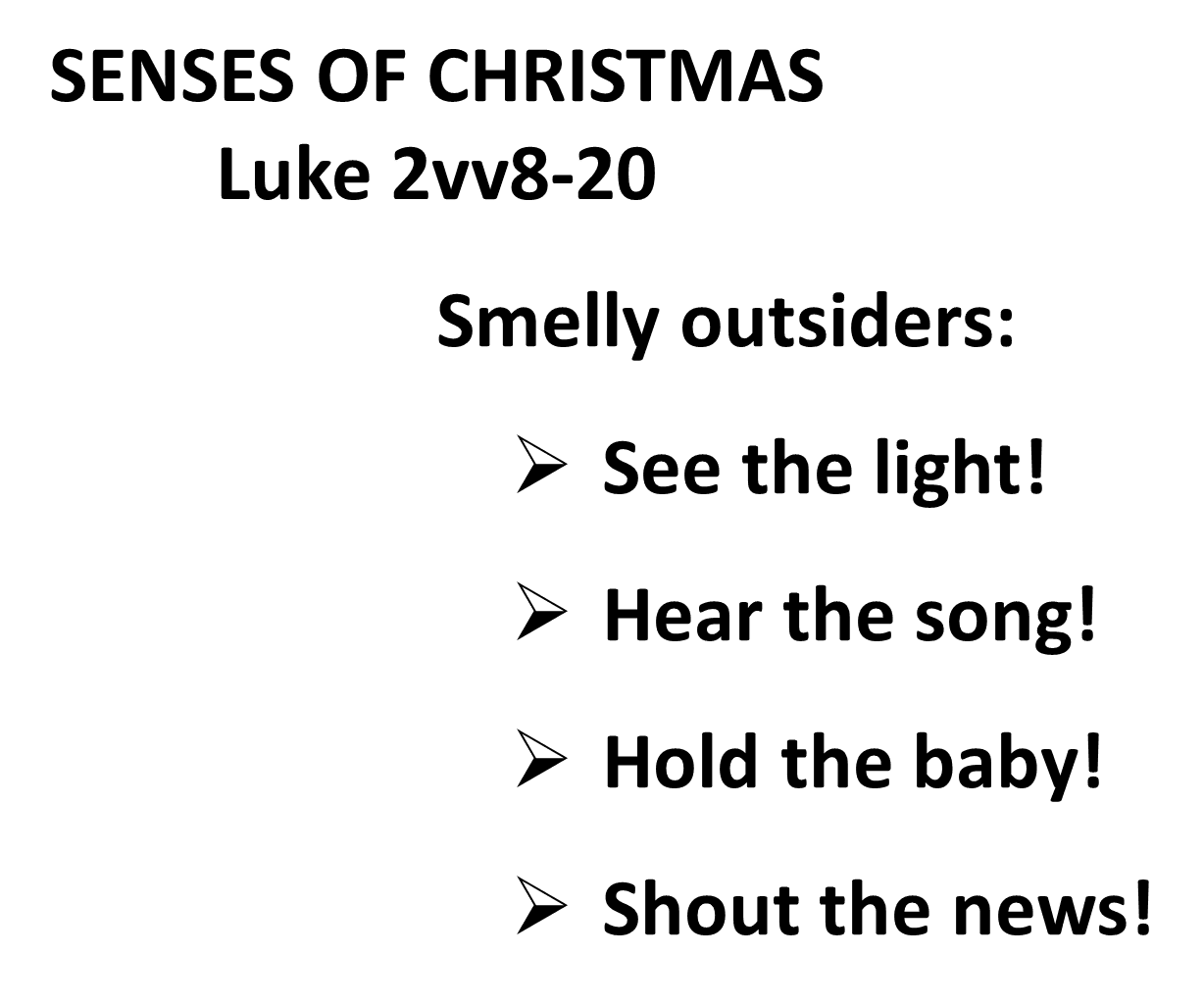
The shepherds are literally outsiders when the angels come to them with the good news. Their marginal location out in the fields near Bethlehem, rather than at the heart of the town, would naturally mean that they are the last to hear what’s going on. Now they are the first to receive and then spread the good news of the Saviour’s birth.


If we think about the birth narratives as a whole, Luke’s local Jewish shepherds of relatively low status naturally form a contrast with Matthew’s (Gentile?) Magi from (far away?) in the East. The shepherds have a relatively short and easy journey, whereas the Magi’s journey presumably required means and leisure. Jew and Gentile, rich and poor, educated and uneducated are all invited!


The shepherds might be seen as the humble of Luke 1:52 who are lifted up or as the poor who have the good news preached to them according to 7:22 (Robert H. Stein, The New American Commentary, B&H 1992, p108).


In An Even Better Christmas (Good Book Company, 2018), Matt Chandler claims:


“In first-century Judea, shepherds were considered outsiders, on the edges of normal society. They were so mistrusted that their testimony was inadmissible evidence in a court of law. First-century Jews believed that God didn’t like shepherds—and they didn’t like them, either. The most pious of Jews would not buy milk, lambs or wool from shepherds; they assumed it was stolen. The religious elite of that day saw them as unclean, filthy, unwanted and outside of God’s favor. A philosopher in Alexandria, one of the centers of the intellectual world at the time, went so far as to say, “There is no more disreputable an occupation than that of a shepherd.”” [I’m not sure where this quotation is from. One online source cites Midrash Ps. 23.2, ed. Buber, Vilna 1891, 99b.12, cited by Jeremias, Jerusalem, p. 311, fn. 42. The next (different) quotation in the online text is from Philo of Alexandria. - https://www.jesuswalk.com/luke/apx1f-shepherds.htm#_ftnref1332]


https://www.thevillagechurch.net/resources/articles/who-did-god-come-for - the online excerpt at least gives no footnotes


Stein claims that “in general shepherds were regarded as dishonest” citing the Babylonian Talmud Sanhedrin 25b, which was initially compiled around 500AD. Sanhedrin 25b rejects the validity of the testimony of shepherds and seems to base this view on the idea that shepherds deliberately and routinely allowed their animals to graze in the fields of others. Stein adds that shepherds were “unclean according to the standards of the law. They represent the outcasts and sinners for whom Jesus came. Such outcasts were the first recipients of the good news.”


Kenneth Bailey (Jesus Through Middle Eastern Eyes, IVP 2008, p35-36) says that shepherds at the time of Jesus were poor, lowly, near the bottom of the social scale and rejected. He cites Joachim Jeremais, “Despised Trades and Jewish Slaves” in Jerusalem in the Time of Jesus (Fortress, 1969) pp304-12 to show that rabbinic sources regarded shepherds as unclean. Bailey says: “Five lists of “proscribed trades” are recorded in rabbinic literature and shepherds appear in three out of the five. These lists hail from post-New Testament but could reflect developing ideas alive in the time of Jesus. In any case, they were lowly, uneducated types.” (p35) Bailey imagines that the shepherds would fear that if they tried to visit the Messiah, his parents would send them away.


Leon Morris (Tyndale, IVP, 1974) similarly thinks that the nature of the shepherds’ calling kept them from observing the ceremonial law (p93). He assumes the shepherds to be “devout men… from a despised class.” (p93)


Bock BECNT 1994 on Luke 2:8 sees the shepherds as “an everyday group” (p214):


“The shepherds are often characterized as representing the “downtrodden and despised” of society, so that the first proclamation of the gospel is said to have come to sinners (Hendriksen 1978: 149; Godet 1875: 1.130; R. Brown 1977: 420 n. 38). The evidence for this view draws on material from rabbinic Judaism (SB 2:113–14; b. Sanh. 25b; Midr. Ps. 23.2 on 23:1 [= Braude 1959: 1.327]). But there are two problems with reading the shepherds as symbols of the hated. First, the rabbinic evidence is late, coming from the fifth century. More importantly, shepherd motifs in the Bible are mostly positive. The NT (Luke 15:4Mark 6:34Matt. 18:12John 101 Pet. 2:25Heb. 13:20Eph. 4:11) portrays shepherds in a favorable light, even describing church leaders with this figure. In the OT, Abraham, Moses, and David were all shepherds at some point in their lives.4 Thus, the presence of the shepherds is not a negative point. Rather, they picture the lowly and humble who respond to God’s message (1:38524:16–18; Fitzmyer 1981: 408).” (p213)


Jesus will of course call himself the good shepherds and pastors are the be under-shepherds. 

Monday, December 18, 2023

Parish Magazine Item for January 2024


From The Rectory


I’m rather addicted to Radio 4 and I’ve heard their Christmas advert many times over the last month. It ends with a quotation from Charles Dickens’ A Christmas Carol: the resolve of the reformed Ebeneezer Scrooge: “I will honour Christmas in my heart, and try to keep it all the year.”


We have tended to front-load Christmas. As soon as the Halloween merchandise is cleared out, we’re confronted with mince pies and Santa hats. But Advent is intended to be a time of waiting and anticipation. Maybe as you read this, Christmas already seems a rather dim memory, but it is traditionally celebrated for Twelve Days leading up to the Epiphany on 6th January. Epiphany commemorates the visit of the wise men from the East to the infant Jesus, and hence his manifestation to the Gentile nations. The Epiphany season runs until the Feast of the Presentation of Christ in the Temple (“Candlemas”) on 2nd February. So, if you were so inclined, you could keep up your Christmas festivities – and your decorations – for forty days.


But what might it mean to try to keep Christmas all the year? Certainly we should say that Christ is not just for Christmas.


For Scrooge, keeping Christmas involves a great deal of chuckling and a new found generosity as he shares a bowl of smoking bishop (a kind of mulled wine which got its name from a mitre-like cup) with Bob Cratchit. In short, Scrooge becomes a good man. Although some people laughed at him, he little heeded it, because his own heart laughed. “It was always said of him that he knew how to keep Christmas well, if any man alive possessed the knowledge.”    


When the Shepherds meet the baby Jesus, they spread the news concerning what they had been told about the child and all who heard it were amazed. They returned, glorifying and praising God for all the things they had heard and seen, which were just as they had been told. “But Mary treasured up all these things and pondered them in her heart.” (Luke 2:17-20)


If we seek to honour Christmas in our hearts, there is so much to treasure up and to ponder. The central mystery of Christmas is the incarnation: of God made flesh. This fact, which divides human history, tells us that God is for us and our world. He loves us enough to come to us and to share our condition. He was born for us that he might die for us. The Redeemer of the world has come. When we take a moment to reflect on the birth, death and resurrection of Jesus, an inward chuckle seems part of the right response.


In the spirit of A Christmas Carol, we might pray that the past reality of Christmas would give us a present joy and a future hope, and that the whole future course of our lives might be reshaped by Christmas. Even more than Dickens, the Bible writers hold out the possibility that even the coldest old sinner can be transformed, if not simply by Christmas, then by Christ. Not every day can be the Christmas feast, but the good news of the Saviour who is Christ the Lord ought to make a difference to us every day.


So today and all the year: Merry Christmas! And God bless Us, Every One!


The Revd Marc Lloyd

Wednesday, November 22, 2023

Suella Braverman and the Meaning of Christmas


From The Rectory


The recently sacked Home Secretary, Suella Braverman, caused controversy, amongst other things, by Tweeting (are we meant to call it X-ing, now?) that: “The British people are compassionate. We will always support those who are genuinely homeless. But we cannot allow our streets to be taken over by rows of tents occupied by people, many of them from abroad, living on the streets as a lifestyle choice.”

The Matt cartoon in The Daily Telegraph quipped that the message in Suella Braverman’s Christmas Card might say that “being born in a stable is a lifestyle choice”. I think Christians would agree!   


Luke’s gospel tells us that the Emperor Augustus had issued a decree that a census should be taken. So Joseph and his betrothed, Mary, had gone from their town of Nazareth in Galilee to register in Bethlehem, the town which great King David of old had been from, because Joseph was of the house and line of David. While they were there, Mary gave birth to Jesus and placed him in a manger because there was no room for them in the inn. But the circumstances of Jesus’ birth were more than the result of historical accidents. The Bible sees them as the fulfilment of God’s plan and of the prophecies that the long-promised Rescuer-King would be born in Bethlehem, the city of his ancestor King David.


In a sense, the Son of God could have remained in heaven without blame. But for him to be born in a stable was a lifestyle choice. He came to our broken world and shared our mess that he might be our Saviour. The Bible says that Jesus did not consider equality with God something to cling on to but made himself nothing, taking the very nature of a servant, being found in human likeness. He did not leave the glory of heaven for a splendid earthly palace. As the Carol says, a stable-place sufficed for the Lord God Almighty Jesus Christ. The Bread of Life was placed in an animal’s feeding trough. Eventually he would die on the cross in our place that our sins might be forgiven.


As another hymn addressed to the Lord Jesus puts it:


Thou who wast rich beyond all splendour, All for love's sake becamest poor; Thrones for a manger didst surrender, Sapphire-paved courts for stable floor. Thou who wast rich beyond all splendour, All for love's sake becomes poor.


Indeed, John’s Gospel tells us that Jesus The Word became flesh and made his dwelling among us. Literally he pitched his tent, or tabernacled amongst us. In Old Testament times, when God’s people were travelling through the desert to the promised land, they worshiped God in a tent, The Tabernacle. And during his earthly ministry, Jesus was an embodied Tabernacle, a kind of mobile walking talking Temple. Jesus was the place to go to meet with God, where the glory of God was revealed. Jesus’ own body would be the place of sacrifice by which sinners like me and you could come into the presence of a holy God.   


Soon Jesus and his family would be refugees as they fled from the murderous King Herod to the safety of Egypt. Later, speaking of himself, Jesus would say: ““Foxes have dens and birds have nests, but the Son of Man has no place to lay his head.” Jesus was made homeless and chose to dwell in the tent of human flesh that we might come home to God.


The Revd Marc Lloyd